When you are ready to start treatment, you do not have time to decipher complicated insurance language. Learning how to quickly verify BCBS insurance for rehab can help you understand your coverage, reduce your out of pocket costs, and get admitted to treatment as soon as possible.
In this guide, you will walk through exactly how to confirm your Blue Cross Blue Shield benefits for detox and rehab, what questions to ask, and how a BCBS friendly program like Miracles Recovery Center can streamline the process for you.
Why verifying BCBS rehab coverage matters
Before you commit to detox or rehab, you need a clear picture of what your plan will pay for and what you may owe. BCBS coverage for alcohol and drug treatment is usually strong, but it is not the same for everyone.
Blue Cross Blue Shield operates as a federation of 34 independent, state based companies. Your benefits, covered levels of care, and in network providers can look very different from one state to another, even between plans like Arizona, Texas, and Illinois [1]. Verifying your insurance up front helps you:
- Avoid surprise bills or uncovered services
- Choose a level of care that is actually covered
- Take advantage of in network benefits and lower costs
- Move into treatment faster with fewer administrative delays
Most BCBS plans follow the Mental Health Parity Act, which means your addiction treatment benefits should be comparable to benefits for medical conditions like diabetes or heart disease [2]. Still, you only know how this applies to you when your specific plan is checked.
Step 1. Gather your BCBS insurance information
To verify BCBS insurance for rehab efficiently, have all of your information ready before you make a call. This will keep you from going back and forth with your insurance company or the treatment center.
You will typically need:
- BCBS member ID number
- Group number
- Plan name or product type, for example PPO, HMO, EPO, Federal Employee Program
- Full name and date of birth of the person needing treatment
- Address and phone number on file with BCBS
- Employer name if it is an employer sponsored plan
- Expected start date for treatment and an approximate length of stay
Having your BCBS member ID number handy is especially important. Treatment centers use it to quickly confirm your benefits, coverage levels, and any prior authorization requirements so they can give you accurate cost information and speed up admission [2].
If you do not have your physical card, you can still locate your information. BCBS offers an online tool where you can enter the first three letters of your member ID to find your local plan’s website, review your claims, and check plan details [3].
Step 2. Contact Blue Cross Blue Shield member services
Your next step is to contact BCBS directly. This is the fastest way to confirm whether addiction treatment is covered and what your financial responsibility might be.
You can verify BCBS insurance for rehab by:
- Calling the toll free customer service number printed on the back of your member ID card. This is the main way to ask questions about health benefits, coverage, and treatment authorizations [3].
- Using your local BCBS company’s secure member portal, where you can view benefits, claims, and often see mental health and substance use coverage details online [3].
If you are covered under the Federal Employee Program, you will want to use the dedicated FEP website, which BCBS provides for coverage and benefit questions specific to federal employees [3].
If you do not have your card, you can still find the correct number or portal access through the BCBS Association contact page, which links you to your local company and updated customer service options through 2026 [3].
Step 3. Ask the right questions about rehab benefits
When you call member services, you want to leave the call with a clear, written picture of your coverage. Preparing your questions ahead of time will help you stay calm and organized.
Here are key questions to ask when you verify BCBS insurance for rehab [4]:
- Plan type and network rules
- Is my plan a PPO, HMO, or EPO?
- Do I need a referral from my primary care doctor to start addiction treatment?
- Do I have out of network benefits for rehab?
- Covered levels of care
- Does my plan cover medical detox, inpatient rehab, residential treatment, PHP, IOP, and standard outpatient services?
- Are there limits on the number of treatment days or sessions per year?
- In network vs. out of network coverage
- What are my in network deductibles, copays, and coinsurance for addiction treatment?
- What are my out of network benefits, if any?
- How much of the cost will BCBS pay for an out of network rehab program after I meet my deductible?
- Pre authorization and utilization review
- Does my plan require prior authorization for detox or residential rehab?
- If yes, who needs to request it and how long does authorization usually take?
- What documentation is needed to approve treatment?
- Cost estimates and parity protections
- How much of my deductible has already been met this year?
- Are my mental health and substance use benefits subject to the same deductibles and visit limits as my medical benefits, in line with parity requirements? [2]
It is a good idea to write down the date, time, and name of the representative you speak with. Ask for a reference number for the call or any pre authorization they provide. This documentation can support appeals or corrections later if there is a billing issue [5].
Step 4. Understand how your BCBS plan type affects rehab coverage
BCBS offers different plan structures, and each one affects how you can use your benefits for detox or rehab. Knowing your plan type helps you make better decisions about where to receive treatment.
BCBS PPO plans usually provide more flexibility. They often cover a portion of out of network rehab costs, sometimes reimbursing 50 to 70 percent after you meet your deductible [1]. PPOs also tend to have fewer restrictions on referrals, which allows you to work with specialized programs, including certain centers that are not directly contracted, when medically necessary.
HMO and EPO plans usually have stricter rules. These plans often:
- Require you to stay in network for non emergency care
- May require referrals from your primary doctor
- Often require prior authorization for detox, inpatient, and sometimes even intensive outpatient services
Verification is especially important with HMO and EPO plans, because going out of network can lead to limited or no coverage except in emergencies [5].
Whatever your plan type is, most BCBS policies include benefits for medical detox, inpatient rehab, and ongoing outpatient support. The details, however, depend on your exact policy and where you live.
Step 5. Let a rehab center verify benefits for you
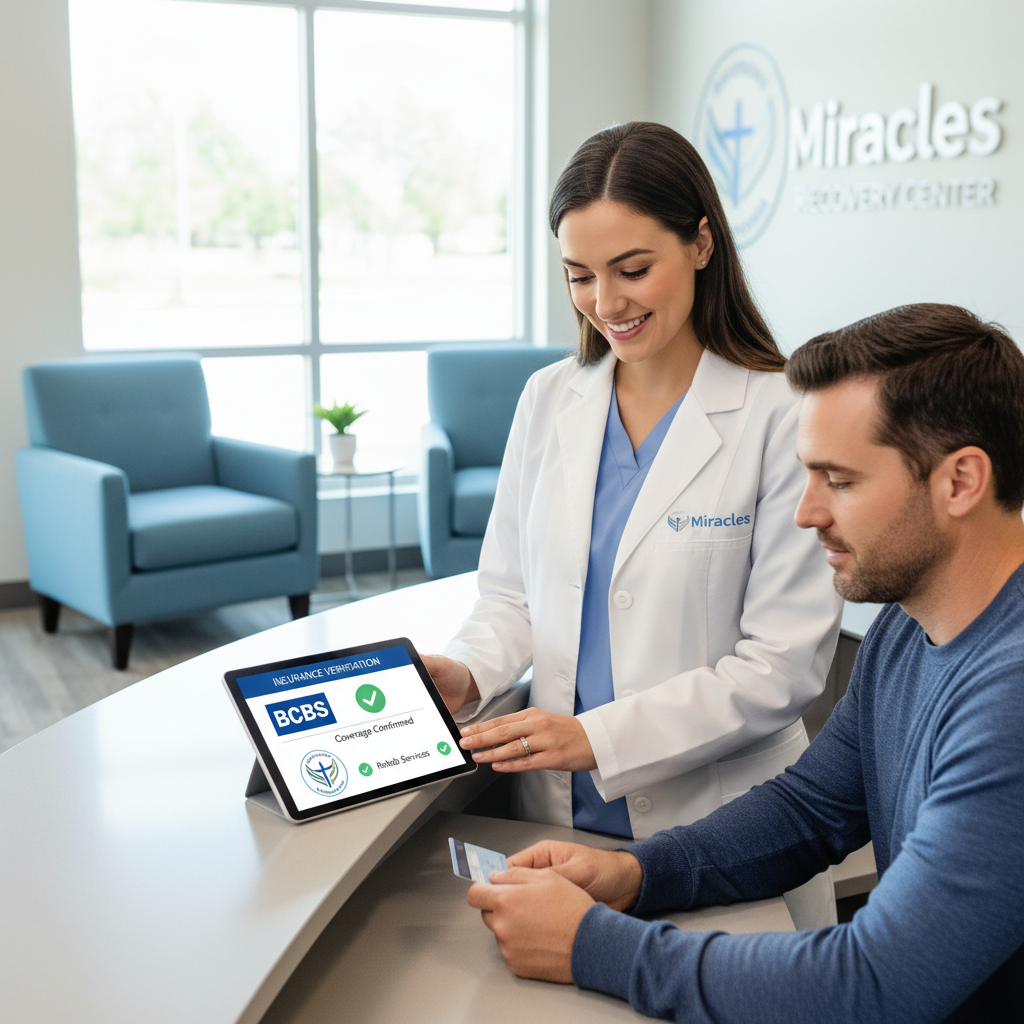
If you feel overwhelmed at the idea of calling BCBS, you do not have to handle the process on your own. Many programs that work regularly with Blue Cross Blue Shield offer free, confidential insurance verification services.
With your consent, a facility can:
- Call BCBS on your behalf
- Confirm your in network and out of network benefits
- Check deductibles, copays, and coinsurance
- Secure pre authorization for detox, residential care, PHP, IOP, and outpatient treatment
- Provide a clear estimate of your expected out of pocket costs
Centers that specialize in BCBS covered care do this every day. For example, Beachview Treatment LLC describes how these checks help secure prior authorizations and reduce administrative barriers so you can enter treatment quickly [5]. Rock View Recovery also highlights how free verification services help you understand complex BCBS rules before you commit to a program [2].
Miracles Recovery Center follows the same approach. When you reach out, you can share your BCBS information once, then a team member can walk you through what your plan covers across different levels of care.
Step 6. Match your verified benefits to the right level of care
Once your benefits are verified, your next focus is choosing the type of treatment that aligns with both your clinical needs and your insurance coverage. BCBS typically recognizes multiple levels of addiction care, many of which you can access through Miracles Recovery Center and similar programs.
These may include:
- Medical detox through a bcbs detox program inpatient or a bcbs drug detox program if you are withdrawing from alcohol, opioids, benzodiazepines, or other substances where medically supervised detox is recommended.
- Inpatient or residential rehab, especially if you need 24 hour support, which can be covered at BCBS in network facilities. If you are seeking treatment in Florida, look for options like bcbs inpatient rehab florida.
- Partial Hospitalization Programs (PHP) or Intensive Outpatient Programs (IOP), which provide structured therapy during the day or evening while you live at home or in supportive housing.
Many people start with detox, then step down to residential or PHP and IOP, depending on their stability and home environment. Your verified benefits help you plan a realistic treatment path that you can afford to follow through.
If alcohol is your primary substance, focusing on an alcohol rehab that takes bcbs can ensure that detox medications, monitoring, and counseling are all integrated into one covered program.
Step 7. Focus on in network advantages and cost savings
Choosing an in network BCBS rehab program usually offers the greatest financial benefit and the smoothest admissions process. When you attend a bcbs approved rehab facility or a blue cross blue shield rehab center, you gain access to:
- Lower deductibles and coinsurance compared to out of network providers
- Pre negotiated rates, which often means significantly lower overall treatment costs
- Faster verification and authorization, which can speed up your admission
- Less paperwork for you, because the center already understands BCBS billing rules
If you have a PPO, you may still choose an out of network program. However, even then, verifying your out of network benefits is essential. Many PPO plans reimburse a portion of treatment costs, often between 50 and 70 percent, once deductibles are met [1]. You can then decide if the remaining cost fits your budget.
Programs like Miracles Recovery Center work to remain accessible to BCBS members. By working closely with your plan, staff can explore all available in network and, when appropriate, out of network options so that cost does not stand in the way of necessary care.
How Miracles Recovery Center simplifies BCBS verification
You may be at a point where making one more phone call feels like too much. That is where Miracles Recovery Center can step in and take the lead.
When you contact Miracles, you can expect:
-
Quick, confidential insurance verification
You provide your BCBS member ID and basic information once. From there, the admissions team calls BCBS, confirms your benefits, and checks requirements like pre authorization, all at no cost to you. -
Clear explanation of your coverage
You do not have to interpret insurance language alone. A specialist will walk through your BCBS covered addiction treatment benefits so you know exactly what is available, what is covered at in network rates, and what you might pay out of pocket. -
Fast placement into the right program
Because Miracles works as a rehab that accepts bcbs insurance and as a drug rehab accepting blue cross blue shield, staff can match you to an appropriate level of care quickly. That may be detox, inpatient, PHP, or IOP, depending on your needs and coverage. -
Ongoing support with authorizations and extensions
As your treatment continues, Miracles collaborates with BCBS on utilization review, any necessary extensions of care, and continued coverage, which decreases the chances of sudden benefit reductions while you are in the middle of your recovery.
By choosing a program that understands BCBS systems and regulations, you reduce delays and focus more on your recovery and less on paperwork.
When treatment is urgent, you should not be stuck in limbo waiting on answers from your insurance company. A BCBS friendly center can close that gap so you can start healing sooner.
Putting it all together: your quick action plan
To move from uncertainty to admission, you can follow a simple sequence:
- Locate your BCBS card or member ID and gather your insurance details.
- Call BCBS member services or log into your online portal and verify your addiction treatment benefits.
- Ask specific questions about plan type, in network rules, covered services, and prior authorization.
- Contact a BCBS focused program like Miracles Recovery Center.
- Allow their team to provide a free, confidential benefits check and cost estimate.
- Choose the appropriate level of care, such as a bcbs covered addiction treatment program, inpatient rehab, or detox.
- Complete any remaining paperwork so you can be admitted quickly.
You do not have to solve this alone. If you are ready to verify BCBS insurance for rehab and explore your treatment options, reaching out to a team that understands Blue Cross Blue Shield coverage is often the fastest and most reliable way to begin.