Understanding rehab intake in Port St. Lucie
If you are looking into rehab intake in Port St. Lucie, you are already taking an important step toward recovery for yourself or someone you love. The intake process is how local facilities learn your history, confirm clinical needs, verify insurance, and match you with an appropriate level of care. When you understand what to expect, you can move faster and with less stress.
In Port St. Lucie, you can choose from hospital-based programs, standalone rehab centers, outpatient rehabilitation, and Medicaid or Medicare funded services, so it helps to know how each handles intake, cost, and coverage before you make calls. You can also use resources like rehab enrollment florida and how to start rehab florida if you want step by step help beyond this guide.
Types of rehab intake in Port St. Lucie
Different facilities in Port St. Lucie use slightly different intake processes, but most fall into a few main categories. Knowing which type you need will help you ask the right questions when you call.
Hospital based dual diagnosis and stabilization
Port St. Lucie Hospital provides a dual diagnosis program for adults 18 and over who have both substance use disorders and mental health conditions. Their intake starts with a clinical assessment of your addiction and psychiatric history, then the team builds a personalized treatment plan that can include medical detox, therapy, and support groups [1]. This type of intake is appropriate if you need medical monitoring, have significant mental health symptoms, or are in crisis.
HCA Florida St. Lucie Hospital also runs an outpatient physical rehabilitation program. Intake there focuses on physical therapy, occupational therapy, or speech therapy needs, so it is more relevant if you are recovering from injury, illness, or surgery. Their 5,000 square foot center uses state of the art equipment and starts with a full assessment at your first visit after your physician sends a referral [2].
Residential and outpatient addiction treatment centers
Several dedicated addiction rehab providers in and around Port St. Lucie use a rehab intake process that centers on addiction severity, co occurring disorders, and your support system. For example, Ambrosia Behavioral Health operates a Florida drug rehab intake center in Port Saint Lucie, with locations at 546 NW University Blvd. #103 and 773 SW Duxbury Ave. Their intake includes a comprehensive assessment of your substance use history, co occurring mental health disorders, family dynamics, and supports so they can create an individualized treatment plan [3].
During this type of intake you can expect questions about:
- Substances used and duration
- Previous treatment attempts
- Medical and mental health diagnoses
- Medications
- Family and living situation
- Legal or employment issues
Other reputable rehab centers serving the Port St. Lucie area include facilities like Banyan Treatment Centers, The Haven Detox, and Genesis House, which together offer detox, inpatient, residential, outpatient, and telehealth treatment options [4]. Even if you are not sure yet which level of care you need, starting the intake conversation will help you narrow it down.
Medicaid, Medicare, and state funded programs
If you rely on Medicaid or Medicare, your rehab intake in Port St. Lucie will also include insurance eligibility and coverage checks. Medicaid is a common source of state funding for addiction treatment in Port Saint Lucie and can cover medical detox, outpatient services, intensive outpatient, partial hospitalization, and group therapy for those who qualify [5]. Programs that accept Medicaid often bundle medication assisted treatment with counseling and behavioral therapies as part of evidence based care.
Medicare can fund up to 100 days of rehab in specific circumstances. At some rehab intake Port St. Lucie facilities, you may qualify for Medicare coverage if you were hospitalized for three consecutive days within the 30 days before admission and have a skilled need, such as wound care or restorative therapies, as defined by Medicare. The first 20 days are paid in full by Medicare, and days 21 through 100 require a copay unless your secondary insurance covers that cost [6].
If you need help understanding your coverage before intake, tools like rehab cost estimate florida and rehab payment options florida can give you ballpark numbers to work with when you speak to admissions.
Step by step: How rehab intake usually works
Although each provider has its own procedures, most rehab intake in Port St. Lucie follows a similar flow. When you know the sequence, you can gather documents in advance, which makes everything faster.
1. First contact and pre screening
Your intake journey usually begins with a phone call or online form. At this stage admissions staff ask brief questions to see if you are a fit for their program and to get a sense of urgency. Expect to provide:
- Basic contact information
- Substances used and approximate amounts
- Any immediate medical or psychiatric risks, such as suicidal thoughts or withdrawal
- Insurance type or whether you will self pay
Hospital based programs use this pre screening to decide if you need emergency care, dual diagnosis stabilization, or a planned admission. Many private facilities also offer confidential consultations, similar to confidential rehab admissions fl, so you can share details without worrying about privacy.
2. Insurance verification or payment planning
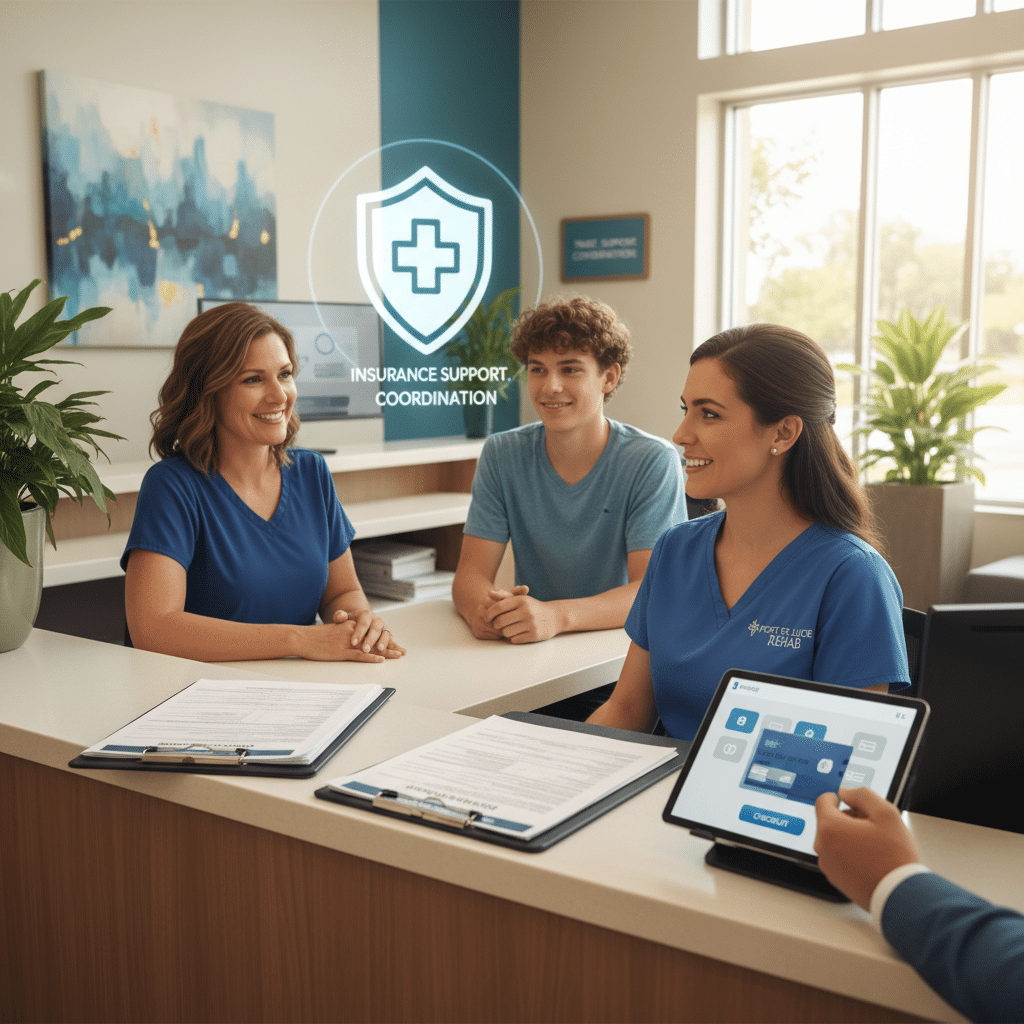
Next, admissions will verify your insurance or discuss payment plans. In Port St. Lucie, many rehab centers accept a mix of commercial insurance, Medicaid, and Medicare. For example, Port St. Lucie Hospital accepts Medicare as well as most HMOs and PPOs and can arrange self pay options to ease financial stress [1].
Recovery.com notes that local facilities such as St. Lucie Comprehensive Treatment Center, Ambrosia Treatment Center, Neuro Psychiatric Addiction Clinic, and 2nd Chance Mental Health Center accept a wide range of commercial plans and government coverage, though policies vary by provider [7]. Some centers help you check Medicaid eligibility and benefits up front, as Legacy Healing Center does for its clients [5].
If you have a specific insurer, you can also review resources such as:
If you prefer or need to pay out of pocket, you can explore self-pay rehab florida and rehab financial assistance fl to understand financing options and potential discounts.
3. Clinical and psychosocial assessment
Once coverage is clear, you move into a more detailed intake assessment. This can take place in person or by phone or video, depending on the facility and your condition. At Port St. Lucie Hospital, for example, the dual diagnosis assessment documents your addiction history and mental health background so the team can design a customized treatment plan [1].
Ambrosia Behavioral Health goes deep into substance use patterns, co occurring mental health issues, family dynamics, and supports so they can choose appropriate evidence based therapies like CBT, DBT, and Motivational Interviewing and build a strong relapse prevention plan [3]. You can expect questions about:
- Physical health conditions and medications
- History of trauma or mental health diagnoses
- Cravings, triggers, and previous relapses
- Employment, housing, and family responsibilities
Although this can feel personal, these details are what allow the team to tailor care to your reality rather than using a one size fits all approach.
4. Level of care recommendation and scheduling
After the assessment, the clinical team recommends a level of care. In the Port St. Lucie area you might be guided toward:
- Medical detox or inpatient stabilization
- Residential rehab for a set period
- Partial hospitalization or intensive outpatient
- Standard outpatient counseling
- Medication assisted treatment combined with therapy
StartYourRecovery.org notes that a three month residential stay in the area can average around 21,500 dollars, with insured patients often paying closer to 4,300 dollars if their plan covers 80 percent. Three months of intensive outpatient treatment may cost about 9,300 dollars before insurance, or roughly 1,800 dollars after typical coverage [8]. Having these ranges in mind can help you evaluate different program lengths and intensities.
If a particular facility does not have a bed or opening right away, staff may help you rank alternative choices. At some rehab intake Port St. Lucie locations, patients can list up to eight preferred facilities for transfer, though actual discharge and transfer depends on bed availability and your physician confirming that you are medically stable [6].
5. Admission day and orientation
On admission day, you usually:
- Sign consent and HIPAA forms
- Review program rules and schedules
- Undergo a brief nursing or medical check
- Have an opportunity to ask questions about daily life in the program
Facilities like rehab intake Port St. Lucie that combine skilled nursing and rehab services may offer a resort like setting with amenities such as wellness centers, creative activities, social events, and restaurant style dining, all within a supervised 24 hour care environment [6]. Understanding the environment helps you or your loved one prepare emotionally for the transition.
If you are looking for more privacy in a residential setting, you can also review rehab with private rooms florida to compare that type of option with more traditional shared accommodations.
Navigating insurance, cost, and payment options
For most families, cost is one of the biggest concerns during rehab intake in Port St. Lucie. Spending a little time upfront on coverage verification and comparisons can prevent surprises later.
Using commercial insurance, Medicaid, and Medicare
Across Port St. Lucie, many programs accept a mix of:
- Commercial insurance plans, such as Florida Blue, UnitedHealthcare, Aetna, Cigna, and Humana
- Medicaid and Medicaid HMO plans
- Medicare
Recovery.com points out that centers like 2nd Chance Mental Health Center accept most major commercial insurers along with Medicaid and Medicaid HMOs, while others such as Harmony Treatment and Wellness Center accept private insurance only and do not take Medicaid or Medicare [7]. This variation makes it important to confirm acceptance before you assume a facility can bill your plan.
Medicaid funded programs in Port Saint Lucie typically cover services like medical detox, outpatient care, intensive outpatient programs, and medication assisted treatment that pairs FDA approved medications with behavioral therapies [5]. If you are not sure whether you qualify, a directory like Drug Rehab USA can point you toward providers who accept Medicaid and are willing to help you verify eligibility.
To make this easier, you can use tools like:
- verify insurance for miracles fl
- miracles in-network providers florida
These resources help you clarify in network options and expected coverage before you commit to a specific program.
Understanding self pay and financial assistance
If you do not have insurance or prefer not to use it, you can still move ahead with rehab intake in Port St. Lucie. Many facilities offer:
- Flat self pay rates for specific program lengths
- Monthly payment plans
- Sliding scale fees
- Scholarship funds or partial grants
StartYourRecovery.org notes that free or low cost options exist through state funded programs like New Horizons of the Treasure Coast and nonprofit organizations, with 24/7 referrals available by dialing 2 1 1 [8]. These can be especially useful if you are between jobs or do not qualify for standard coverage.
For a broader look at cost and payments statewide, you can review:
- rehab cost florida
- rehab payment options florida
- rehab financial assistance fl
These guides explain how deductibles, copays, and self pay rates typically work in Florida addiction treatment.
A helpful rule of thumb is to ask admissions to explain your estimated out of pocket cost for the entire planned episode of care, not just the daily or weekly rate, so you have a complete picture before admission.
Transportation and location logistics
Once your rehab intake is approved, you still need to figure out how you will physically get to and from the program. Port St. Lucie facilities offer several options.
Local and medical transportation options
If you are transferring from a hospital or another facility to a rehab intake Port St. Lucie location, transportation can often be arranged for you. PSL Rehab Care explains that ambulance transport is possible when medical criteria are met, while wheelchair vans or family vehicles can be used if it is safe, with possible charges depending on the circumstances. A social worker can help coordinate these arrangements so you are not managing logistics alone [6].
When you are entering outpatient programs like the HCA Florida St. Lucie Hospital outpatient rehab center, you will usually arrive on your own. Because outpatient appointments require a physician referral, it helps to combine any necessary lab work or doctor visits on the same day if you are traveling from a distance [2].
If you are comparing facilities across Florida, the resource rehab transportation options florida can help you explore airport shuttles, rideshare strategies, and what to ask facilities about travel support.
Choosing a location within or near Port St. Lucie
You have multiple choices within the Port St. Lucie region, so location becomes part of your intake decision. For example:
- Ambrosia Treatment Center has intake offices directly in Port Saint Lucie and combines inpatient and outpatient services [3].
- New Horizons of the Treasure Coast and Florida Center for Recovery in nearby Fort Pierce offer additional options for co occurring disorder treatment and crisis stabilization [8].
- Port St. Lucie Hospital provides hospital based detox and dual diagnosis programs for those who need closer medical monitoring.
StartYourRecovery.org notes that many people in Port St. Lucie can access detox, inpatient, outpatient, medication assisted treatment, therapy, and sober living without traveling outside the area, unless specialized or luxury amenities are a priority [8]. Staying local can make it easier for family to participate in sessions and for you to transition into nearby aftercare.
If you want broader help comparing choices and planning transitions, rehab consulting service florida may be another resource.
What to expect after rehab intake
Planning ahead for what happens after intake can help you stay focused and reduce anxiety about the unknown. Port St. Lucie programs generally emphasize continuing support and relapse prevention.
Treatment, skills, and family involvement
During treatment at facilities like Port St. Lucie Hospital, you can expect a combination of medical support, therapy, and skill building that targets both substance use and mental health symptoms. The dual diagnosis program specifically aims to help you maintain sobriety and mental wellness after discharge by teaching stress management and relapse prevention strategies [1].
Ambrosia Behavioral Health integrates evidence based therapies such as CBT, DBT, and Motivational Interviewing and provides family therapy so loved ones can be part of your healing process and learn how to support healthy boundaries [3]. Many clients find that involving family improves communication at home and supports long term recovery.
Aftercare, alumni, and community resources
Strong aftercare planning is built into intake and treatment at several Port St. Lucie programs. Ambrosia, for instance, makes aftercare a core component of its Florida drug rehab process, connecting you to outpatient services, support groups, and alumni networks before you discharge [3]. These supports help you maintain accountability and community once you return to everyday life.
You also have access to community based groups. Multiple AA and NA meetings operate in or near Port St. Lucie, with established intergroups and schedules, so you can find in person peer support at nearly any stage of recovery [4].
If you want to understand how different programs structure aftercare and alumni services before you enroll, you can use rehab application process florida and miracles recovery admissions florida as checklists for questions to ask.
Taking your next step toward intake
Rehab intake in Port St. Lucie involves many moving parts, but you do not have to handle them alone. Your next steps can be as simple as:
- Choosing whether you need hospital based, residential, or outpatient care.
- Verifying your insurance with a tool like verify insurance for miracles fl or confirming Medicaid or Medicare eligibility.
- Calling one or two programs that fit your needs to schedule an intake assessment.
- Planning transportation with the help of facility staff or resources like rehab transportation options florida.
- Asking about payment plans or financial assistance if cost is a concern.
If you want guidance throughout this process, rehab enrollment florida and how to start rehab florida can walk you through planning, applications, and admissions in more detail.
By learning how rehab intake works in Port St. Lucie, you put yourself in a stronger position to choose the right program, understand your financial responsibilities, and enter treatment with clarity about what comes next.