Choosing a self-pay rehab in Florida can feel overwhelming at first. You are balancing cost, location, program quality, and practical issues like transportation and how quickly you can get admitted. When you understand how self-pay rehab in Florida works, you can compare your options with more confidence and choose a program that truly fits your needs.
This guide walks you through what “self-pay” really means, how to compare costs and coverage, what to look for in program quality, and the practical steps to enroll and get started.
Understanding self-pay rehab in Florida
Self-pay rehab in Florida simply means you pay some or all of your treatment costs out of pocket instead of, or in addition to, using insurance. This can apply whether you are uninsured, underinsured, or choosing a program that is out-of-network with your plan.
You are not alone if you are considering this route. As of 2024, 682 out of more than 790 drug rehab facilities in Florida accept self-payment or cash as a way to pay for treatment, and hundreds offer sliding scale fees to increase affordability [1]. This gives you a wide range of options from basic to luxury.
Self-pay does not mean you cannot use insurance at all. Many people combine insurance benefits with self-pay to lower out-of-pocket costs. If you have coverage, it is worth checking what your plan will pay and then deciding what level of self-pay investment makes sense for you.
Weighing self-pay versus insurance
If you have any type of health insurance, your first step should be to understand what is covered. The Affordable Care Act classifies substance use disorder treatment as an essential health benefit, which means qualifying health plans must include addiction treatment coverage and cannot treat it as a pre-existing condition [2].
However, there are tradeoffs you should weigh:
- Most ACA marketplace plans involve cost sharing, so you pay deductibles and copays even when rehab is covered [3].
- High deductibles are common, so you might still face several thousand dollars out of pocket before insurance starts paying [3].
- Many plans emphasize outpatient before inpatient and may require prior authorization or a referral from your primary care physician for residential care [3].
On the other hand, ACA plans cover inpatient treatment and medical detox, which can significantly reduce what you need to pay yourself [2]. Over 87 percent of enrollees qualify for financial assistance, which can further ease costs [2].
If you know or suspect you have coverage, you can check your benefits and network status through tools like:
- Verify insurance for Miracles FL
- Miracles in-network providers Florida
- Rehab accepting Aetna Florida
- Rehab accepting Cigna FL
Even if you ultimately choose a self-pay rehab in Florida, understanding your insurance options can help you avoid leaving benefits unused.
Estimating the cost of self-pay rehab
When you look at self-pay rehab Florida options, it helps to start with realistic cost ranges. Prices vary by setting, length of stay, and amenities, but national and state data give you a useful reference point.
In general:
- Inpatient or residential programs without insurance can range from about 5,000 to 80,000 dollars or more, depending on length and facility type [4].
- Outpatient and intensive outpatient programs tend to be more affordable, typically from 1,400 to 10,000 dollars without insurance [4].
Florida specific data show:
- The average cost of addiction treatment is about 56,640 dollars, with inpatient rehab averaging 49,981 dollars and outpatient about 8,305 dollars [1].
- Florida ranks 21st nationwide in addiction treatment affordability, which puts it in the moderate range compared with other states [1].
These are averages, not what you must spend. Many Florida centers accept self-pay and then use:
- Sliding scale fees based on income.
- Shorter stays paired with strong outpatient follow up.
- Payment plans to spread costs out.
If you want a clearer picture before you call individual programs, you can review tools such as rehab cost Florida and request a rehab cost estimate Florida so you can compare numbers side by side.
Comparing inpatient and outpatient self-pay options
Choosing between inpatient and outpatient self-pay rehab in Florida comes down to your clinical needs, your home environment, and your budget.
Inpatient or residential treatment means you live at the facility temporarily. This often includes:
- 24 hour support and supervision
- A structured schedule of groups and individual therapy
- On site medical care, especially during detox
- A break from triggers at home or work
Florida is in the mid range of states for residential rehab costs [5], and inpatient will usually be the most expensive choice. However, it can be critical if you need medical detox, have severe withdrawal risk, or live in an unsafe or highly triggering environment.
Outpatient care allows you to live at home while attending treatment several times a week. Outpatient rehab in Florida is:
- Less intensive and less costly than inpatient or residential treatment [5].
- Easier to fit around job or family responsibilities.
- Often used as step down care after an inpatient stay.
For many people paying out of pocket, a hybrid path works best. You might invest in a shorter residential stay during detox and early stabilization, then transition to a more affordable outpatient or intensive outpatient program. A program that offers multiple levels of care under one roof can help you design a sequence that fits your budget and recovery goals.
Considering state-funded and low cost alternatives
If self-pay costs feel out of reach, it is important to know what other options exist in Florida. State-funded rehab programs provide free or low cost treatment for residents with limited resources or inadequate insurance coverage [6].
Key points to know:
- Eligibility usually requires a diagnosis of substance use disorder plus proof of Florida residency and income or financial need. Medicaid or other state funded insurance may also qualify you [6].
- These programs are significantly more affordable than private rehab and may be no cost for those who qualify [6].
- Due to limited funding and high demand, you may encounter waiting lists. High risk individuals such as pregnant women are often prioritized for faster admission [6].
While you are waiting for a state funded bed, you might access outpatient services, medication assisted treatment, or medical maintenance options to support your recovery in the meantime [6].
If you fall in between, and cannot qualify for state funded care but are worried about full private pay costs, review rehab payment options Florida and rehab financial assistance FL to see what sliding scales, scholarships, or payment plans might be available.
Evaluating program quality and credentials
Cost matters, but quality is just as important when you choose a self-pay rehab in Florida. You are investing your money and your trust, so you want to know the program meets clinical and ethical standards.
When you research facilities, look for:
- Accreditation and licensing. Third party accreditations and appropriate state licensure signal that a center meets recognized standards for patient care, safety, and operations. Guides such as RehabNet highlight Florida centers that hold these credentials and use evidence based therapies with strong patient satisfaction ratings [7].
- Evidence based treatment. Ask whether the program uses therapies that have been scientifically validated, such as cognitive behavioral therapy, motivational interviewing, relapse prevention, and medication assisted treatment when appropriate.
- Integrated care for co occurring disorders. Many people face both substance use and mental health conditions. An effective program will treat both sides together, not in isolation.
- Qualified staff. Confirm that licensed clinicians, medical professionals, and addiction specialists are involved in your day to day care.
- Individualized treatment planning. High quality rehab centers assess your background, substance use history, mental health, and support system, then build a plan specific to you rather than using a one size fits all model.
You can use resources such as rehab consulting service Florida if you want help comparing facilities and treatment models. Quality indicators should carry as much weight as amenities when you are making your final decision.
Clarifying level of comfort and amenities
Once you know a program is clinically sound, you can think about comfort and environment. For some people, a basic setting is fine. For others, especially if you are taking time away from work or family, a more private and comfortable environment matters.
You may want to ask:
- Are there private or semi private rooms available, or will you share with multiple others
- What does a typical day look like, from wake up to lights out
- Is there outdoor space, fitness equipment, or holistic activities such as yoga or meditation
- What are the rules about phone and family contact
If privacy is a priority, explore options like rehab with private rooms Florida so you understand what is available at different price points. Keep in mind that higher cost does not always equal better care, but a setting where you feel safe and comfortable can support deeper engagement in treatment.
Location, transportation, and access
Rehab location affects more than your travel time. It shapes who can visit, how easily you can return for follow up care, and whether you feel far enough from your everyday triggers.
You might ask yourself:
- Do you want to stay close to home so family can be involved, or farther away to create more distance from stressful environments
- How easy will it be to get to the facility from your home or from an airport
- Does the center help with rides from airports or major transit hubs
Transportation support can reduce barriers to starting treatment. Some programs offer in house or contracted transportation or help you coordinate rides to and from the facility. You can review rehab transportation options Florida to see what kinds of support you might expect.
If you are local to specific areas, such as the Treasure Coast, looking into region specific options like rehab intake Port St. Lucie can simplify travel and aftercare planning.
Understanding payment plans and assistance
Even if you decide to self pay, you do not necessarily need to pay in full upfront. Many Florida rehab centers that accept self payment also offer structured options to make cost more manageable.
When you speak with admissions, ask directly about:
- Payment plans. Can you spread payments out over several months or the course of your stay
- Sliding scale fees. Do they adjust rates based on your income or financial situation
- Scholarships or partial assistance. Are there limited funds reserved for people with financial need
- Combined funding. Can you apply insurance benefits to some services while self paying for room, board, or non covered services
Across Florida, 423 drug rehab facilities offer sliding scale fees to help those without insurance pay for addiction treatment [1]. In practice, this can mean the difference between delaying treatment and being able to start now.
If you prefer to talk through options in one place, you can use rehab financial assistance FL or a similar resource to see what might be available before you commit to a particular facility.
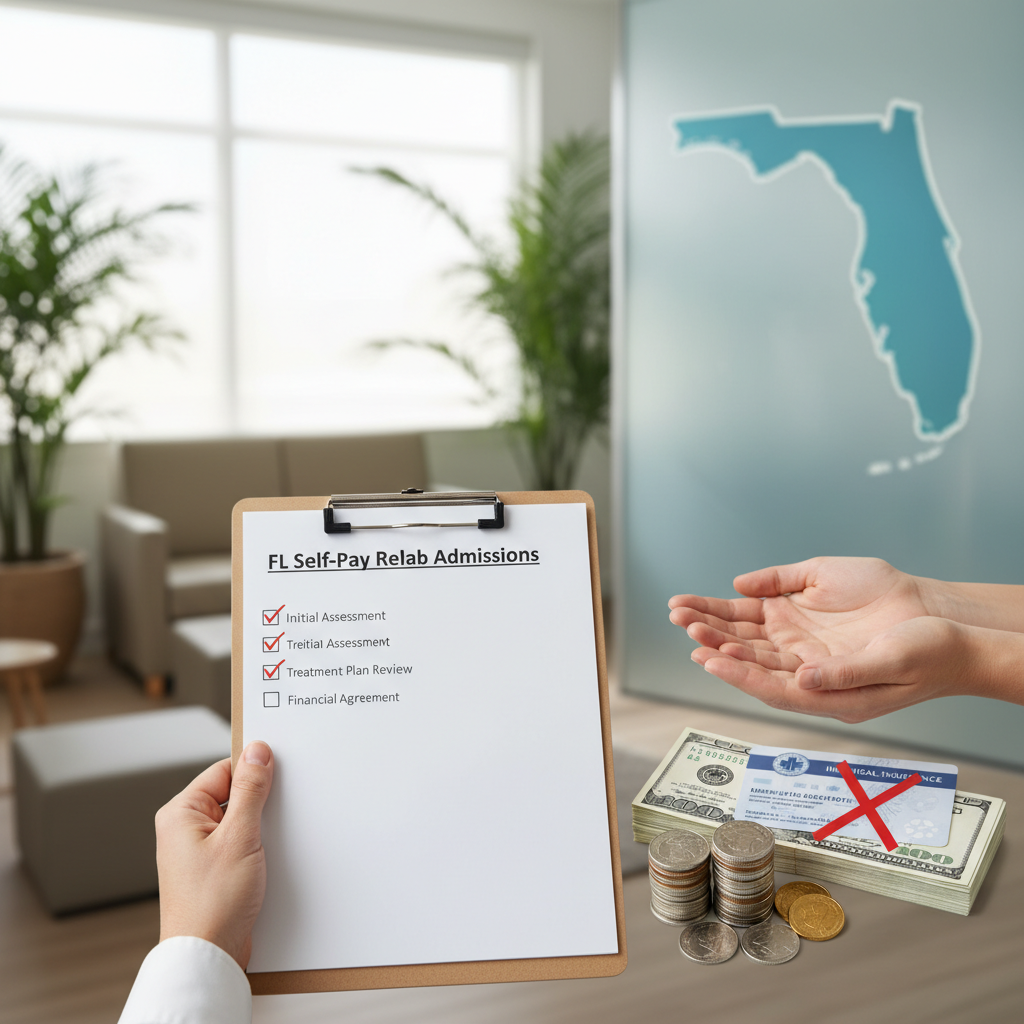
Enrolling in a Florida self-pay rehab
Once you have identified one or more programs that fit your needs, it helps to know what to expect from the enrollment process. Each center has its own steps, but most follow a similar pattern.
1. Initial inquiry and confidential call
You typically start with a phone call or online inquiry. This first contact is your chance to ask high level questions about:
- Available levels of care
- Self pay rates and payment options
- Bed availability or waitlists
- Whether they can meet any special needs you have
Reputable facilities maintain strict confidentiality. If privacy is a concern for you or your family, you can look for services that emphasize confidential rehab admissions FL so you feel comfortable sharing sensitive information.
2. Clinical and financial pre-screen
Next, an intake or admissions specialist will usually complete a pre-screen. They will ask about:
- Substances used, how often, and for how long
- Any history of withdrawal complications, overdoses, or medical issues
- Mental health history and current symptoms
- Current medications
- Support system at home and living situation
On the financial side, you will discuss whether you are using insurance, self pay, or a combination. If you plan to enroll at Miracles or a similar program, this is when you might connect with Miracles recovery admissions Florida or a dedicated admissions team to align payment details with your clinical needs.
3. Application and verification
Many centers have a formal application process. This may include:
- Completing intake forms
- Providing ID and basic documentation
- Signing releases so the center can coordinate with other providers, if needed
If you are using any insurance benefits, this is when the team will verify your coverage and explain how much your plan might pay versus what would remain as self pay. You can track the steps through resources such as rehab application process Florida.
4. Admission date and logistics
Finally, you will schedule an admission date and plan logistics. This may involve:
- Arranging transportation, whether with family, rideshare, or facility supported options
- Receiving a packing list and guidelines about what to bring
- Coordinating time off work or family responsibilities
If you have not started this step yet, guides like how to start rehab Florida, rehab enrollment Florida, and miracles recovery admissions Florida can walk you through what to expect from the moment you decide to say yes to treatment.
Using comparison tools and external resources
You do not have to compare self-pay rehab Florida options entirely on your own. A few external resources can help you see the broader landscape:
- Rehabs.com outlines the wide range of inpatient and outpatient costs without insurance and explains community resources, nonprofit support, sliding scales, and payment plans that can make treatment accessible even if you are uninsured [4].
- DrugAbuseStatistics.org compares the cost of different types of treatment, showing how inpatient, outpatient, and residential programs differ in intensity and pricing, and noting that private facilities usually cost more than state run centers but often provide more comprehensive services [5].
- RehabNet provides a Florida specific guide with top rated centers, payment options, and a 24/7 helpline staffed by specialists who can help you find appropriate services without any obligation to enroll [7].
These tools can complement the more detailed information you receive when you speak directly with individual programs.
When you invest in self-pay rehab, you are not just paying for a bed. You are investing in safety, medical care, therapeutic support, and a structured space to build a sustainable recovery.
Bringing it all together for your decision
Choosing the best self-pay rehab in Florida is not about finding a perfect program on paper. It is about finding the right fit for your needs, resources, and timing. As you compare options, you can ask yourself:
- Does this program offer the right level of care for my current situation
- Is the cost clear, and do I understand all self pay, insurance, and payment plan options
- Do I feel comfortable with the location, setting, and length of stay
- Are the treatment approaches evidence based and tailored to me, not just generic
- Is the admissions team responsive, respectful, and willing to answer my questions
If you keep these questions in mind and use the tools available to you, it becomes much easier to narrow your choices and move forward. Whether you combine insurance with self pay or fund treatment entirely out of pocket, you have options in Florida, from private residential care to affordable outpatient and state funded programs.
The most important step is the one you are taking now, exploring how to get help. When you are ready to move from research to action, you can reach out to an admissions team, confirm your benefits, and begin the process of entering treatment that matches your life and your goals.